
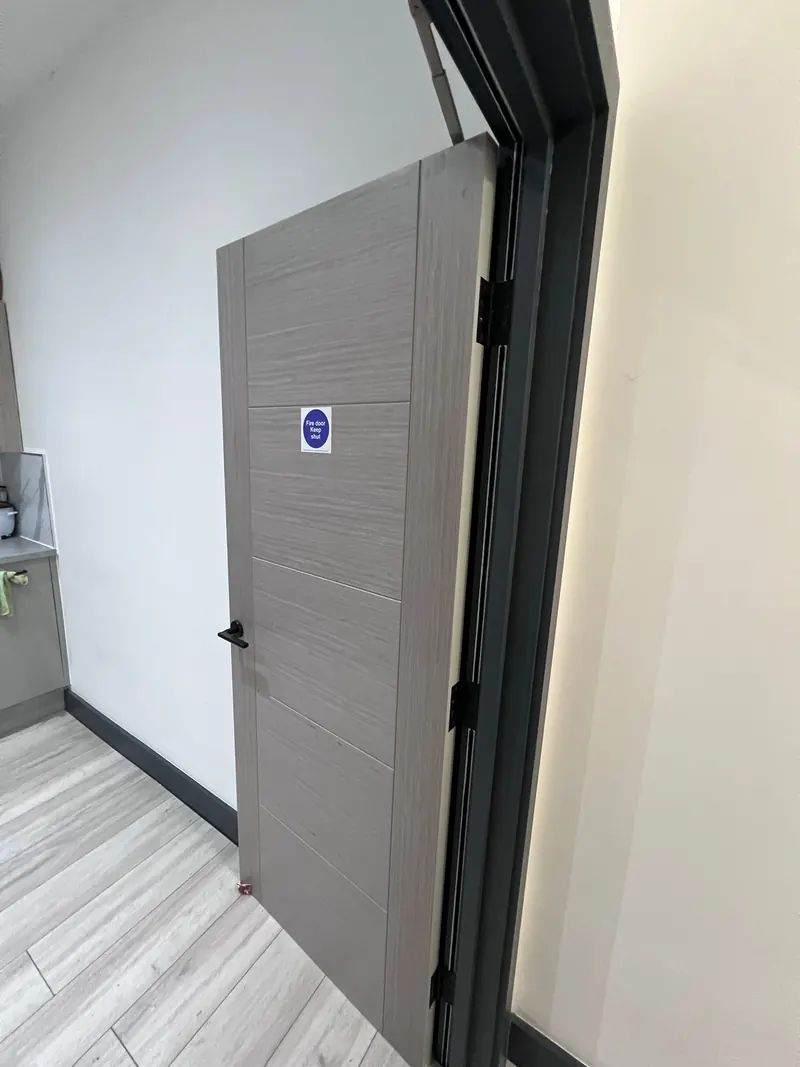
/// Fire Door Inspections
Who needs a fire door inspection?
If you're the responsible person for a block of flats, an HMO, an office, a shop or any other non-domestic building, the Regulatory Reform (Fire Safety) Order 2005 requires a fire risk assessment and fire safety measures kept in good order. Fire doors are one of the most important of those measures, and one of the most often damaged.
In residential buildings over 11 metres, the Fire Safety (England) Regulations 2022 go further: communal fire doors must be checked at least every three months, and flat entrance doors at least every year on a best-endeavours basis.
What we check on every door
Each door is checked as a complete assembly, not just the leaf:
- Certification: label or plug showing the door's fire rating, where present
- Leaf and frame: damage, holes, alterations and how the frame is fixed and sealed to the wall
- Gaps around the leaf and at the threshold, against the door's certification
- Intumescent strips and smoke seals: present, continuous and undamaged
- Hinges: number, condition and fixings
- Self-closer: closes the door fully from any angle and engages the latch
- Latch, lock and other ironmongery, including letterboxes and spy holes
- Vision panels and glazing: fire-rated glass and intact glazing beads
- Signage, wedges, hold-open hooks and anything stopping the door closing
What you get
A written report listing every door by location, marked pass or fail, with photos and the remedial work needed. Any fire stopping problems we see on the visit, such as open holes in riser or meter cupboards, are noted too. We can then quote to carry out the repairs or replace doors that can't be repaired.
Prices
£250 + VAT per site visit, covering up to 10 doors. Each additional door is £25 + VAT. Remedial work is quoted separately after the inspection.
The rules that apply
Fire Safety (England) Regulations 2022
In force since 23 January 2023. In residential buildings over 11 metres with two or more flats, communal fire doors must be checked at least every three months, and flat entrance doors at least every 12 months on a best-endeavours basis. In any building with two or more flats, residents must be given fire safety instructions and information about fire doors.
Regulatory Reform (Fire Safety) Order 2005
The Fire Safety Order puts a legal duty on the responsible person for non-domestic premises, including the common parts of blocks of flats, to carry out a fire risk assessment and act on it. The Fire Safety Act 2021 confirmed that in buildings with two or more flats this covers the structure, external walls and flat entrance doors. In London the Order is enforced by the London Fire Brigade.
BS 8214:2016
The British Standard code of practice for timber-based fire door assemblies, covering how they are specified, installed and maintained. A fire door only performs if the whole assembly matches its tested design: frame fixing, gaps, intumescent seals, hinges, closer and latch.
This is a summary, not legal advice. Your fire risk assessment sets out what your building needs.